Parker Roth · 9 October 2026
Excavations During Porano Road Upgrades Expose Etruscan Artifacts with Implications for Biodiversity and Artisan Collaboration
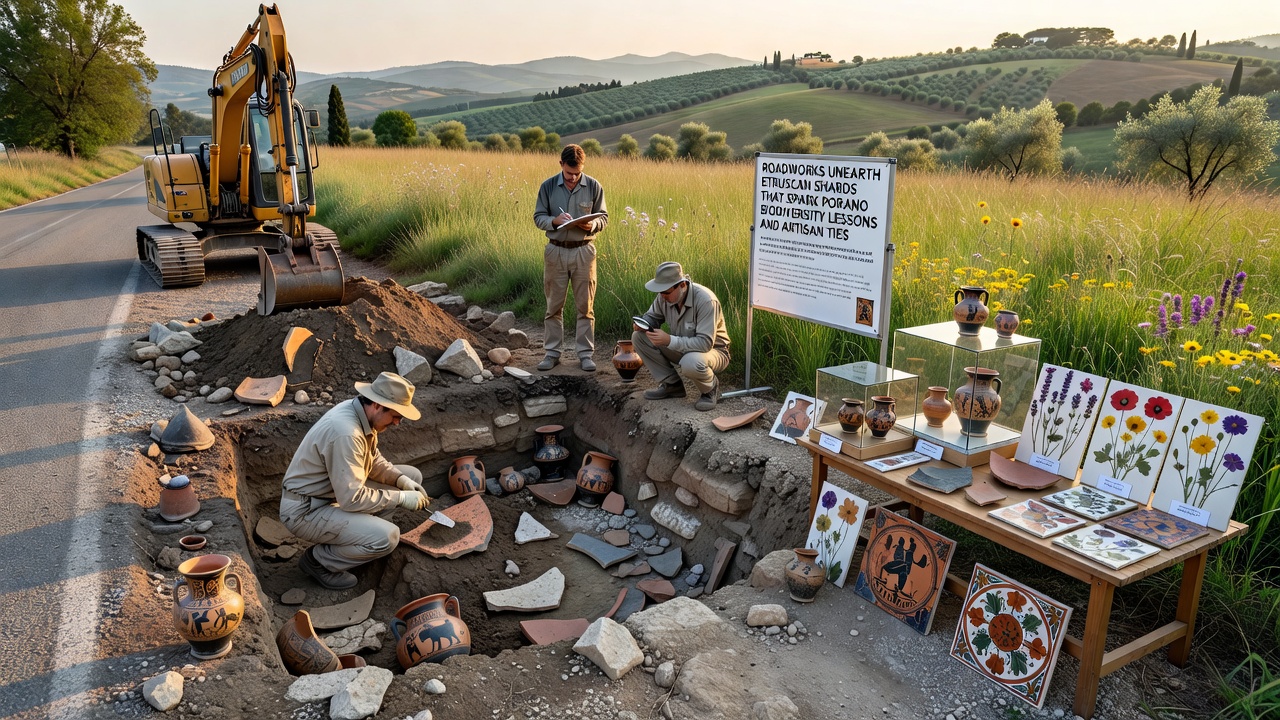
Road construction crews in Porano encountered fragments of Etruscan pottery during upgrades that began in October 2026, and these shards have prompted researchers to examine connections between ancient practices and contemporary biodiversity management along with local artisan networks. The discoveries occurred along routes near the village center where layers of soil revealed ceramic pieces dating back over two thousand years, according to reports from the Italian Ministry of Culture. Experts note that such finds occur periodically in Umbria because the region sits atop extensive Etruscan settlements, yet the specific context of these shards has drawn attention to patterns in ancient land use that align with modern ecological strategies.
Details of the Discoveries and Initial Analysis
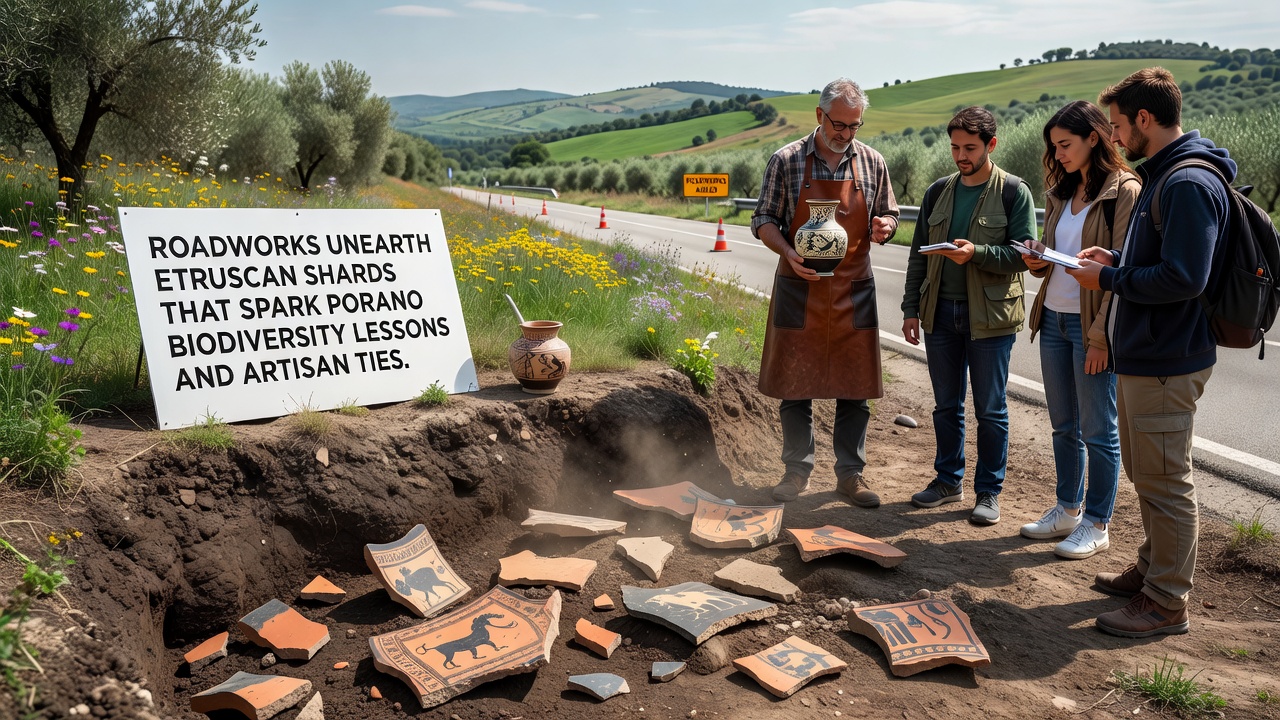
Archaeologists from regional heritage offices documented over fifty shards during the initial phase of excavation, and these pieces included remnants of storage jars along with decorative elements that suggest agricultural and ritual functions. Teams employed stratigraphic methods to date the materials, which placed many fragments between the seventh and fourth centuries BCE, while soil samples indicated the presence of olive cultivation residues consistent with Etruscan farming techniques. Observers from the University of Perugia collaborated on preliminary cataloging, and their work revealed that the pottery compositions matched local clay sources, which points to on-site production rather than imported goods. This evidence has encouraged further surveys along the construction corridor to map potential settlement boundaries without halting the infrastructure timeline.
Links Between Ancient Practices and Biodiversity Insights
Researchers have identified parallels between Etruscan land management visible in the shard contexts and current biodiversity efforts in the Porano area, where terraced fields and water retention systems appear in the artifact patterns. Data from the European Environment Agency shows that traditional polyculture approaches, similar to those inferred from the pottery, support higher species diversity in Mediterranean landscapes compared to monoculture fields, and Porano officials have referenced these historical models when planning habitat corridors alongside new roads. One study conducted by a team at the University of British Columbia examined comparable Etruscan sites across central Italy and found that integrated crop and wild plant zones preserved soil health over centuries, which aligns with biodiversity metrics tracked in Umbria today. Construction planners incorporated these observations by adjusting drainage designs to preserve microhabitats identified near the find locations, and this adjustment occurred after consultation with environmental consultants in late 2026.
Connections to Modern Artisan Networks
The unearthed shards have also influenced pottery cooperatives operating in Porano and surrounding villages, where artisans have incorporated motif reconstructions into new works while maintaining traditional firing methods. Groups such as the Umbrian Craft Alliance reported increased interest in collaborative projects following the October 2026 announcements, and several workshops now host sessions that combine archaeological replicas with contemporary functional pieces. Evidence from regional trade records indicates that Etruscan pottery production historically supported local economies through resource sharing, and current cooperatives draw on similar principles when sourcing clays from nearby quarries to reduce transport impacts. These ties have extended to educational programs where students visit active dig sites, and participants learn how ancient techniques inform sustainable material choices without disrupting the road project schedule.
Broader Regional Context and Ongoing Work
Porano lies within a network of Umbrian sites where infrastructure projects regularly intersect with heritage layers, and the current road upgrades form part of regional connectivity improvements outlined in 2025 planning documents. Officials coordinated with heritage authorities to establish buffer zones around high-density shard areas, which allowed work to proceed while preserving stratigraphic integrity for future study. Figures from the Italian Institute for Environmental Protection reveal that areas with preserved ancient agricultural patterns exhibit measurable gains in pollinator populations and soil retention, metrics that local planners now reference when evaluating post-construction landscaping. Additional surveys scheduled through 2027 aim to expand mapping efforts, and these initiatives build on the initial finds to create a more complete record of Etruscan activity in the immediate vicinity.
Conclusion
The combination of roadwork discoveries and their follow-up investigations continues to generate documentation on Etruscan material culture in Porano, while the resulting data supports practical applications in biodiversity planning and artisan production. Regional authorities maintain open channels for updates as excavation proceeds, and these efforts integrate historical evidence with present-day resource management across the landscape.